Industry Insights · Fabric Sourcing 2026
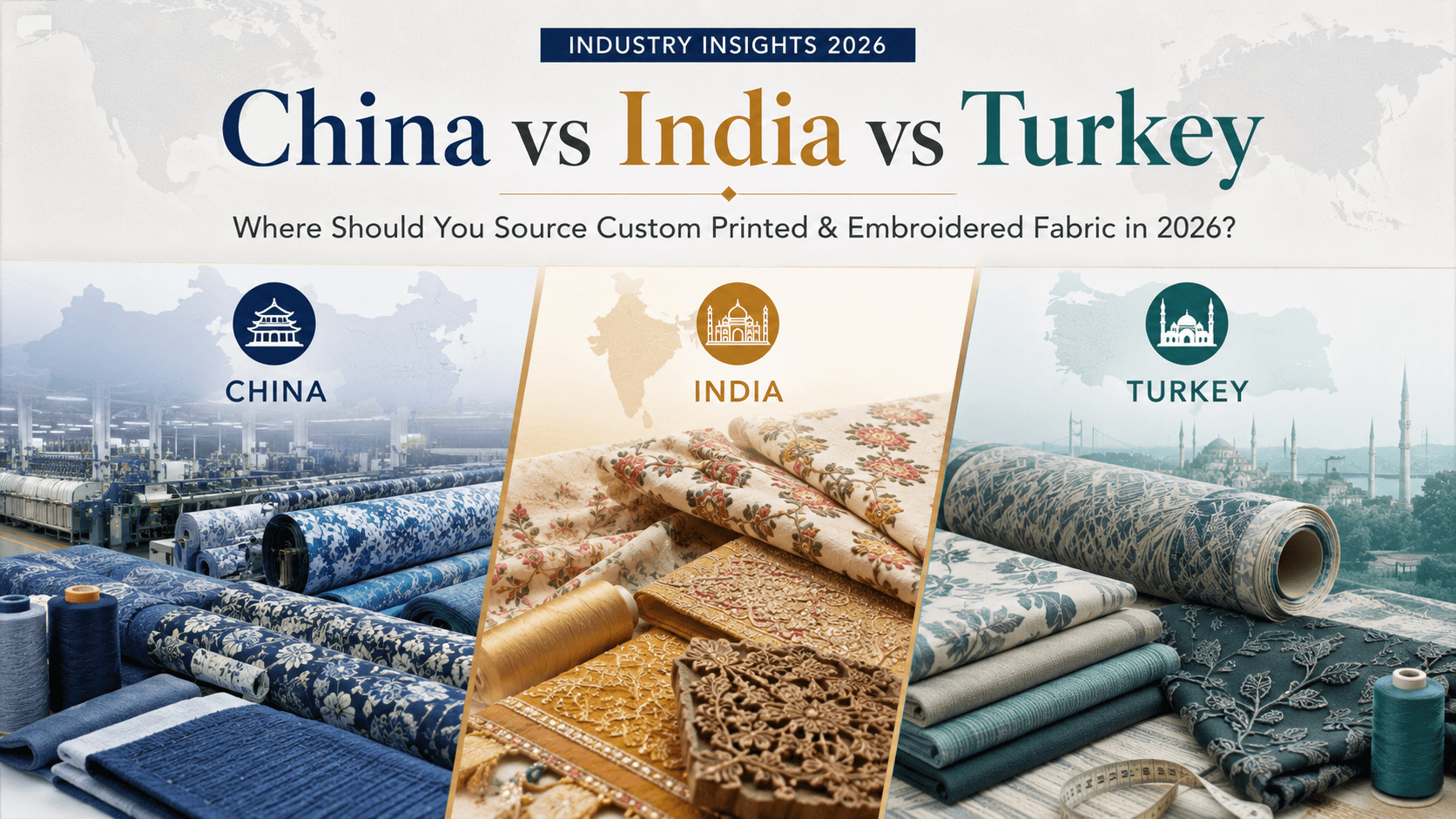
China vs India vs Turkey: Where Should You Source Custom Printed & Embroidered Fabric in 2026?
For fashion brands, sourcing managers, fabric buyers, apparel manufacturers, and designers, the question in 2026 is no longer simply which country offers the lowest fabric price. China, India, and Turkey each serve different sourcing needs. The better question is: which sourcing base best matches your fabric project, development complexity, lead time, compliance expectations, and target market?
China
Best for integrated custom fabric development.
Strong in digital printing, embroidery, jacquard weaving, fabric finishing, sampling, and compound textile solutions.
India
Best for handcraft value and textile heritage.
Strong in hand embroidery, cotton-based textiles, craft identity, decorative handwork, and artisanal fabric details.
Turkey
Best for European nearshoring.
Strong in EU-facing apparel supply chains, shorter delivery cycles, quick replenishment, and regional response speed.
Custom Fabric Sourcing Capability Snapshot
The chart below summarizes the practical sourcing fit of China, India, and Turkey for custom printed, embroidered, jacquard, and composite fashion fabric projects. It is a buyer-oriented capability map, not a country ranking.
China
Integrated development
Digital printing
Machine embroidery
Composite fabric projects
India
Handcraft embroidery
Cotton textile base
Industrial integration
Custom fabric consistency
Turkey
EU nearshoring
Fast replenishment
Custom fabric variety
Large textile-market access
Note: This is an editorial sourcing-fit visualization based on capability categories discussed in this article, not a statistical market ranking.
Introduction: The New Fabric Sourcing Question in 2026
Imagine that you are a sourcing manager comparing three supplier options. China offers strong supply-chain integration and technical capability. India offers craft heritage and industrial ambition. Turkey offers speed and proximity to Europe. The question is not “which country is best,” but “which country is best for this specific fabric project?”
In 2026, fabric sourcing decisions are shaped by shorter fashion development cycles, the growth of digital textile printing, stronger demand for custom printed and embroidered fabrics, supply-chain diversification, EU-facing compliance pressure, and more sample-first sourcing strategies.
The growth of the global digital textile printing market also changes how buyers evaluate fabric suppliers. Faster artwork conversion, flexible print development, lower sample barriers for selected projects, and better fabric-to-garment planning are becoming more important.
Key point: This article is not a country ranking. It is a sourcing decision framework for custom printed fabrics, embroidered fabrics, jacquard fabrics, and composite fashion fabric development.
Sourcing Base 01
China — The Integrated Textile Development Hub
China is no longer only a cost-driven sourcing base. For many custom fabric projects, its strongest advantage is integrated textile development. Fabric supply, dyeing, printing, embroidery, jacquard weaving, finishing, sampling, and export coordination can often be connected within one supply-chain ecosystem.
Textile Cluster Advantage
Keqiao, Shaoxing is one of China’s most important textile clusters and a major sourcing hub for international fabric buyers. For buyers who need custom fabric development, this cluster-based structure can make sourcing more efficient because fabric trading, dyeing and printing, finishing, embroidery, jacquard weaving, sampling, and bulk production coordination can be connected within a concentrated textile environment.
For a broader explanation of this sourcing environment, see our guide to the Keqiao textile sourcing hub.
Digital Printing and Position Printing Capability
China’s digital textile printing capability is especially relevant for fashion brands that need artwork development, repeat adjustment, color testing, and printed fabric sampling. This includes digital direct printing, digital position printing, and placement-based print development for garment panels and decorative fabric applications.
For dresses, resortwear, kaftans, women’s fashion, and special garment panels, digital position printing projects can provide better control over motif placement, border layout, and finished garment appearance.
Why China Works
- Integrated textile supply chain
- Digital printing and embroidery coordination
- Jacquard, finishing, and sampling support
- Flexible development options with qualified suppliers
- Suitable for composite fashion fabric projects
Risks to Manage
- Supplier quality varies
- Lowest quotation may create quality risk
- Compliance must be verified by supplier
- Communication and production follow-up remain important
- Tariff exposure may affect some markets
Composite Fabric Development
This is where China becomes especially relevant for custom fashion fabric sourcing. Many modern fabrics are not simply printed or embroidered. They may combine embroidery with printing, jacquard with digital printing, lace or mesh with color effects, or custom artwork with fabric base selection and finishing.
For example, a buyer may need embroidered mesh with printed color effects, jacquard fabric with additional finishing, or a digital print that must align with embroidery placement. In these cases, an integrated supplier can reduce coordination complexity. Buyers can review artwork, base fabric, color direction, embroidery technique, finishing, and production feasibility within one development process.
This is why China is often suitable for buyers looking for custom embroidery services, embroidered fabric projects, digital printing, and jacquard woven fabric development under a more connected supply chain.
Section conclusion: China is strongest when the buyer needs integrated development, custom printed fabrics, embroidered fabrics, jacquard fabrics, and compound textile solutions.
Sourcing Base 02
India — Handcraft Value and Industrial Ambition
India should not be evaluated only through the lens of industrial speed. Its strongest value is often found in textile heritage, handcraft identity, cotton-based fabrics, and decorative handwork. For designers who want artisanal detail rather than industrial uniformity, India can be highly relevant.
Handcraft and Heritage Value
India has strong value in hand embroidery, zardozi, chikankari, mirror work, craft-based decorative textiles, and high-value artisanal details. These techniques are not always designed for maximum industrial uniformity. Their appeal often comes from craftsmanship, cultural identity, and decorative richness.
For fashion brands, this can be useful when the collection needs handcraft identity. Bridal details, luxury craft trims, resort collections, and decorative panels can all benefit from India’s craft ecosystem.
Textile Market Expansion and Policy Support
India is investing heavily in textile manufacturing, integrated textile parks, and export-oriented development. Government-backed programs such as PM MITRA textile parks show India’s ambition to build larger and more integrated textile manufacturing capacity.
For buyers, this means India should not be seen only as a handcraft sourcing base. It is also working toward stronger industrial capability. However, the development level can still vary significantly by region, supplier, process, and product category.
Best Fit for India
India is best when the product requires craft value, hand embroidery, cotton-based textiles, or artisanal decorative identity. It may be less efficient when the project requires highly integrated industrial development across multiple fabric processes.
Business Communication Advantage
India can be attractive for Western buyers because of English communication, long-standing export relationships, cotton textile experience, craft traditions, and a large labor force. For brands that require ongoing design discussion, English communication can reduce some sourcing friction.
Risks to Manage
Supplier consistency can vary significantly. Lead times may depend heavily on region, factory, material availability, and process complexity. Automated digital printing and finishing ecosystems are uneven across suppliers. If a project requires printing, embroidery, fabric sourcing, finishing, and quality control to be connected tightly, the buyer may need to coordinate several suppliers.
Sourcing Base 03
Turkey — Europe’s Nearshoring Advantage
Turkey’s main advantage is not lowest cost. Its strongest value is proximity to Europe, shorter delivery cycles for European buyers, familiarity with EU-facing apparel supply chains, and quick-response production capability.
EU-Facing Advantage
Turkey has a long-standing trade relationship with the European Union. The EU–Türkiye Customs Union supports Turkey’s role as a nearshoring option for European apparel and textile buyers.
Shorter Delivery to Europe
For European buyers, Turkey can support faster replenishment, shorter logistics cycles, lower distance-related risk, and more responsive communication within nearby time zones. This is especially useful for brands that need to react quickly to market demand or replenish successful styles during the season.
Speed
Shorter delivery cycles for European buyers and stronger replenishment value.
Location
Nearshore position helps EU-facing apparel brands reduce distance-related risk.
Response
Useful for quick-response production, private label apparel, and market replenishment.
Compliance and Buyer Familiarity
Turkey may have an advantage in EU-facing communication and regulatory alignment, but PFAS, chemical restrictions, sustainability documentation, traceability, and testing requirements still need supplier-level verification.
Product Strengths
Turkey is strong in apparel manufacturing, knits, woven garments, European private label supply, nearshore production, and quick-response replenishment. For buyers who source finished garments for the European market, Turkey can be highly practical.
Risks to Manage
Turkey is usually not the lowest-cost option compared with many Asian suppliers. Capacity can be more limited for large custom fabric projects, and it may be less suitable if the buyer needs broad fabric-market access or complex semi-finished fabric development. Advanced composite fabric development may depend heavily on the specific supplier.
Section conclusion: Turkey is strongest for EU-focused brands that prioritize speed, nearshoring, and replenishment over lowest unit cost.
Six-Dimension Comparison: China vs India vs Turkey
Instead of judging only by price, buyers should compare each sourcing country across capability, development speed, process integration, and market fit.
| Dimension | China | India | Turkey |
|---|---|---|---|
| Integrated textile supply chain | Very Strong | Developing | Selective |
| Digital printing capability | Strong | Supplier-dependent | Moderate |
| Embroidery strength | Machine + Scale | Handcraft | Stable |
| Composite fabric development | Very Strong | Limited by supplier | Selective |
| Lead time advantage | Strong with integration | Varies | Strong for EU |
| Best buyer type | Custom fabric buyers | Craft-led brands | EU replenishment |
Reading this chart: China is stronger when the buyer needs process integration; India is stronger when handcraft identity matters; Turkey is stronger when European delivery speed is the main priority.
Fabric Sourcing Decision Flow
Use this simple sourcing flow to decide whether China, India, Turkey, or a mixed strategy is more suitable for your project.
Need integrated custom development?
If your project requires printing, embroidery, jacquard, finishing, sampling, and bulk coordination, China is usually the stronger fit.
Recommended sourcing base: China
Need craft identity?
If the collection depends on hand embroidery, artisanal details, cotton base fabrics, or decorative craft value, India can be a better choice.
Recommended sourcing base: India
Need fast EU delivery?
If your priority is European nearshoring, shorter logistics cycles, replenishment speed, and quick response, Turkey is often more practical.
Recommended sourcing base: Turkey
Need risk diversification?
If your brand needs flexibility across different product categories, use different countries for their strongest capabilities instead of relying on one sourcing base.
Recommended sourcing strategy: Mixed sourcing
Which Country Should You Choose?
The best sourcing choice depends on what the buyer is trying to develop. A buyer sourcing basic fabric should not use the same decision logic as a buyer developing custom printed and embroidered fashion fabrics.
| Buyer Need | Best Fit | Reason |
|---|---|---|
| Custom printed and embroidered fashion fabrics | China | Strong integration of digital printing, embroidery, jacquard, and finishing |
| Handcraft embroidery and artisanal details | India | Strong craft heritage and handwork value |
| EU fast-fashion replenishment | Turkey | Nearshore logistics and EU-facing supply chain experience |
| Composite fabric development | China | Better ability to connect multiple processes under one supply chain |
| Organic cotton or craft-led collections | India | Strong cotton and artisanal textile base |
| EU-focused quick response production | Turkey | Faster access to European markets |
| Sample-first custom fabric development | China | Stronger development ecosystem when supplier is technically capable |
| Diversified sourcing strategy | Mix of all three | Use each country for its strongest capability |
The smartest 2026 sourcing strategy may not be choosing one country. It may be using China for technology-integrated custom fabrics, India for handcraft value, and Turkey for EU nearshore replenishment.
2026 Trend Outlook: From Country Sourcing to Capability Sourcing
The real sourcing shift in 2026 is not simply from one country to another. Buyers are moving from country selection to capability selection.
01
China is shifting from cost advantage to technology integration.
02
India is moving from craft strength toward industrial upgrading.
03
Turkey benefits from European nearshoring and shorter response cycles.
04
Compliance is becoming supplier-specific, not only country-specific.
05
Capability matters more than choosing a country by reputation.
How to Evaluate a Chinese Custom Fabric Supplier
If a buyer decides to explore China for custom printed or embroidered fabrics, the next step is not choosing the lowest quotation. It is evaluating whether the supplier has the right development capability.
1. Digital Printing Capability
Ask whether the supplier can support digital direct printing, position printing, artwork adjustment, color checking, and fabric-specific printing methods.
2. Embroidery and Jacquard Integration
Check whether the supplier can develop embroidery, jacquard, and digital printing together, or whether the buyer must coordinate multiple factories.
3. Sample Development
A strong supplier should help turn design concepts into production-ready fabric, not only quote a price.
4. Quality Control
Review how the supplier checks fabric defects, print consistency, embroidery quality, finishing, shrinkage, and color stability.
5. Export Follow-Up
A supplier should communicate clearly, provide production updates, and respond quickly when technical issues appear.
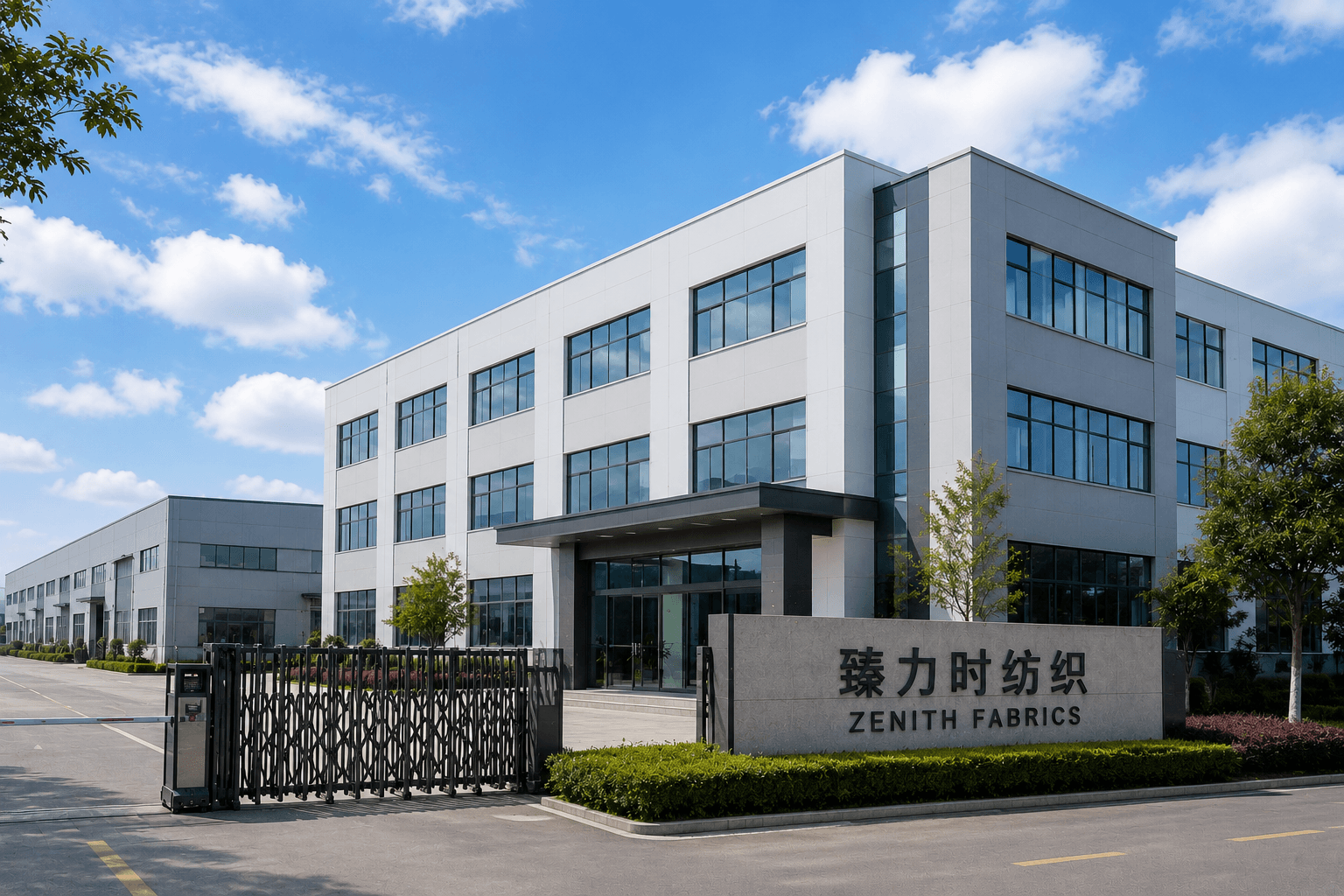
Located in Keqiao, Shaoxing, Zenithfabrics focuses on custom embroidery services, jacquard woven fabric, and digital direct printing for fashion fabric projects. For brands sourcing custom printed and embroidered fabrics from China, this integrated development approach can reduce coordination complexity and improve project control.
Buyers can also review our digital position printing projects to understand how artwork placement, fabric structure, and garment application can be considered together during custom fabric development.
Conclusion — There Is No Best Country, Only the Best Fit
There is no universal best sourcing country for every fabric project. China, India, and Turkey each serve different needs. The right choice depends on fabric category, development complexity, target market, delivery expectations, and supplier capability.
Choose China when the project requires custom fabric development, digital printing, embroidery, jacquard weaving, finishing, and process integration. Choose India when craft value, hand embroidery, cotton, or artisanal textile identity matter most. Choose Turkey when European lead time, replenishment speed, and nearshoring are the priority.
For serious buyers, samples and supplier capability matter more than quotation alone. The real question is not which country can produce the cheapest fabric. The real question is which supplier can help you turn a design idea into consistent, production-ready fabric.
Looking for Custom Printed or Embroidered Fabric from China?
Zenithfabrics supports custom embroidery, jacquard weaving, digital direct printing, and digital position printing for fashion fabric projects. If you are developing a new collection, our team can help evaluate fabric base, artwork, technique, sample feasibility, and production direction.
about
Zenithfabrics
Based in Keqiao, Shaoxing — the heart of China's textile industry — Zenithfabrics specializes in high-quality embroidered mesh, embroidery lace, and custom decorative fabrics.