Industry Insights · Custom Fabric Sourcing 2026
Custom Fabric Sourcing Trends 2026: Why Low MOQ and Digital Manufacturing Are Reshaping Fashion Supply Chains
Fashion fabric sourcing is moving from volume-first purchasing to flexibility-first development. For brands, designers, and apparel manufacturers, the real advantage in 2026 is not only finding a lower fabric price. It is finding a supplier that can support low MOQ fabric manufacturing, fast sampling, digital textile printing, custom embroidery, and scalable production when the design is validated.
Lower Risk
Low MOQ helps brands test before scaling.
Smaller initial orders reduce inventory pressure and allow buyers to validate colors, prints, embroidery, and market response.
Faster Development
Digital manufacturing shortens sampling cycles.
Digital printing, artwork adjustment, position printing, and sample coordination make custom fabric development more responsive.
Flexible Scaling
Start small, validate, then reorder.
The strongest supply chain is not always the cheapest. It is the one that can move from sample to small batch to bulk production smoothly.
The 2026 Shift: From Volume-First to Flexibility-First Sourcing
Custom fabric sourcing is no longer only about unit price and large-scale production. Fashion brands increasingly need smaller starting quantities, faster product testing, and suppliers that can connect fabric development with production planning.
01
Demand is harder to forecast
Brands need sourcing models that can react to uncertain fashion demand instead of relying only on large seasonal commitments.
02
Inventory risk is more visible
Unsold fabric and finished garments can damage cash flow more than a slightly higher small-batch unit cost.
03
Sampling speed matters
Designers need to test prints, embroidery, colorways, fabric bases, and finishing before committing to bulk production.
04
Supplier collaboration is critical
Buyers need suppliers that can advise on technique, MOQ, fabric base, production feasibility, and repeat-order planning.
The Fabric Sourcing Model Is Changing After Years of Supply Chain Volatility
After several years of supply chain disruption, demand uncertainty, cost pressure, and changing consumer behavior, fashion buyers are rethinking how they source fabric. Traditional sourcing logic often began with a large forecast, a large order, and a long production calendar. That model still works for stable basics, but it is less suitable for collections where demand is uncertain, color trends move quickly, and product testing is essential.
The State of Fashion 2026 report highlights how brands are adjusting sourcing and improving efficiency in response to cost and market pressure. For fabric buyers, this means flexibility is becoming part of sourcing strategy, not just a nice extra service.
Vogue Business has also described fashion supply chain resilience in 2026 as a key concern shaped by tariffs, climate issues, regulation, digital tools, and supplier collaboration. In practical terms, buyers need fabric suppliers who can help them test, adjust, and scale instead of forcing every project into a large bulk order from the beginning.
Key point: The new fabric sourcing question is not only “How cheap is this fabric?” It is “How quickly can we develop, test, adjust, reorder, and scale this fabric without creating unnecessary inventory risk?”
Trend 01 · Low MOQ
Why Low MOQ Fabric Manufacturing Is Becoming More Important
Low MOQ fabric manufacturing is becoming more important because many brands no longer want to place large orders before they understand market response. A designer may want to test one print in several colorways. A fashion brand may want to launch a limited capsule collection. An online seller may want to validate one embroidered fabric before committing to a larger reorder.
In these situations, low MOQ is not simply a request for a cheaper factory. It is a risk-control strategy. The buyer accepts that a smaller order may not always have the lowest unit price, but it can prevent overbuying, reduce dead inventory, and make product development more manageable.
Why Buyers Ask for Low MOQ
- To test new fabric designs before scaling
- To reduce inventory exposure
- To support smaller fashion drops
- To test prints, embroidery, and fabric bases
- To build a repeat-order strategy after validation
What Low MOQ Should Not Mean
- It should not mean poor quality
- It should not mean unclear production standards
- It should not mean no repeat-order plan
- It should not mean random fabric development
- It should not replace proper sampling and approval
For a professional custom fabric supplier, low MOQ should be connected to a clear development process: fabric selection, artwork review, sample making, approval, small-batch production, and repeat-order planning. The goal is not to keep every order small forever. The goal is to start with controlled risk and scale when the product is proven.
Trend 02 · Digital Manufacturing
Digital Textile Printing Is Changing Custom Fabric Development
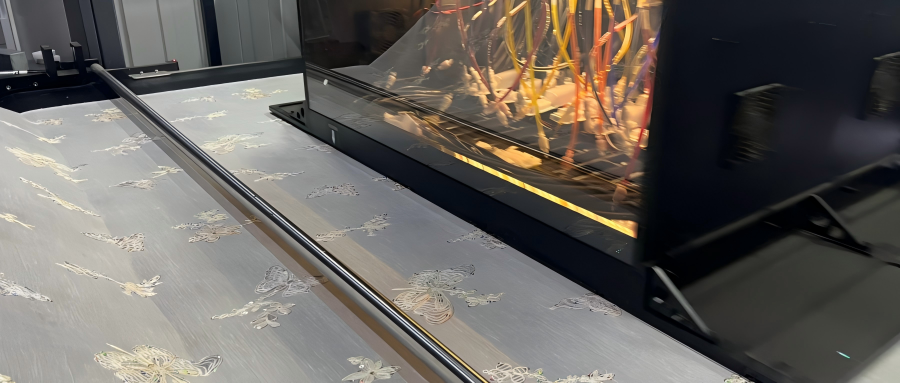
Digital textile printing is one of the main reasons low MOQ fabric development has become more practical. Compared with traditional screen printing or rotary printing, digital printing can make artwork testing, color adjustment, and small-batch custom printed fabric development more flexible.
Market estimates vary by research provider, but most forecasts agree that digital textile printing is expanding. Mordor Intelligence estimates the digital textile printing market forecast at USD 3.09 billion in 2026, growing toward USD 4.28 billion by 2031. Future Market Insights gives a higher market-size estimate and notes that variable-data inkjet textile printing is helping reduce traditional minimum order constraints.
For fashion fabric buyers, the important point is not the exact market-size number. The practical change is that digital printing makes it easier to move from artwork to sample, from sample to small batch, and from small batch to repeat production.
Artwork Testing
Digital printing allows buyers to test artwork direction, repeat size, placement, and colorways before committing to a larger order.
Small-Batch Production
Custom printed fabric can be developed in smaller quantities, especially when the project does not require traditional screen preparation.
Faster Decisions
Buyers can review sample results, adjust artwork, approve colors, and plan production faster than with many traditional workflows.
For Zenithfabrics, this trend connects directly with digital direct printing and digital position printing projects. Digital direct printing is suitable for all-over custom printed fabric development, while digital position printing helps brands control motif placement for garment panels, borders, dresses, kaftans, and fashion applications where print layout matters.
Digital Printing vs Traditional Printing for Custom Fabric Development
The right printing method depends on design, quantity, fabric base, cost target, and production goal. Digital printing is not always a replacement for traditional printing, but it is often more flexible for custom development and low MOQ projects.
| Comparison Point | Digital Textile Printing | Traditional Screen / Rotary Printing |
|---|---|---|
| Best Use | Custom development | Large repeat orders |
| MOQ Flexibility | Higher flexibility | Usually higher MOQ |
| Artwork Adjustment | Faster adjustment | More setup required |
| Colorway Testing | Suitable | Less flexible |
| Bulk Cost Efficiency | Project-dependent | Strong at scale |
Trend 03 · Flexible Manufacturing in China
From Mass Production to Flexible Custom Manufacturing in China
China’s role in fashion fabric sourcing is changing. For many buyers, China is no longer only a place for large-volume production. It is increasingly used for integrated custom fabric development, where digital printing, embroidery, jacquard weaving, finishing, sampling, and export coordination can be connected within one supply-chain ecosystem.
This is especially relevant in textile clusters such as Keqiao, Shaoxing. A concentrated textile environment can make it easier to source fabric bases, test printing, develop embroidery, review finishing, and move from sample to bulk production. For a deeper background, see our guide to the Keqiao textile sourcing hub.
Buyers comparing sourcing regions can also read our China vs India vs Turkey fabric sourcing comparison, which explains how China, India, and Turkey serve different sourcing needs. In this article, the focus is narrower: why flexible custom manufacturing is becoming more important for fashion fabric development.
Integrated Process Support
- Digital direct printing
- Digital position printing
- Custom embroidery
- Jacquard weaving
- Fabric finishing and sample coordination
Buyer Benefits
- Fewer coordination gaps
- Clearer development feedback
- Better sample-to-bulk transition
- More flexible custom fabric options
- Stronger control over mixed-process projects
For example, a brand may need printed fabric with embroidery accents, a jacquard base with additional finishing, or an embroidered mesh that must match a seasonal color palette. In these cases, the strongest supplier is not necessarily the one with the lowest quotation. It is the supplier that can evaluate design feasibility, recommend suitable techniques, control sampling, and plan repeat production.
This is where services such as custom embroidery services and jacquard woven fabric development become part of a broader flexible manufacturing strategy.
Low MOQ Does Not Mean Every Project Should Stay Small
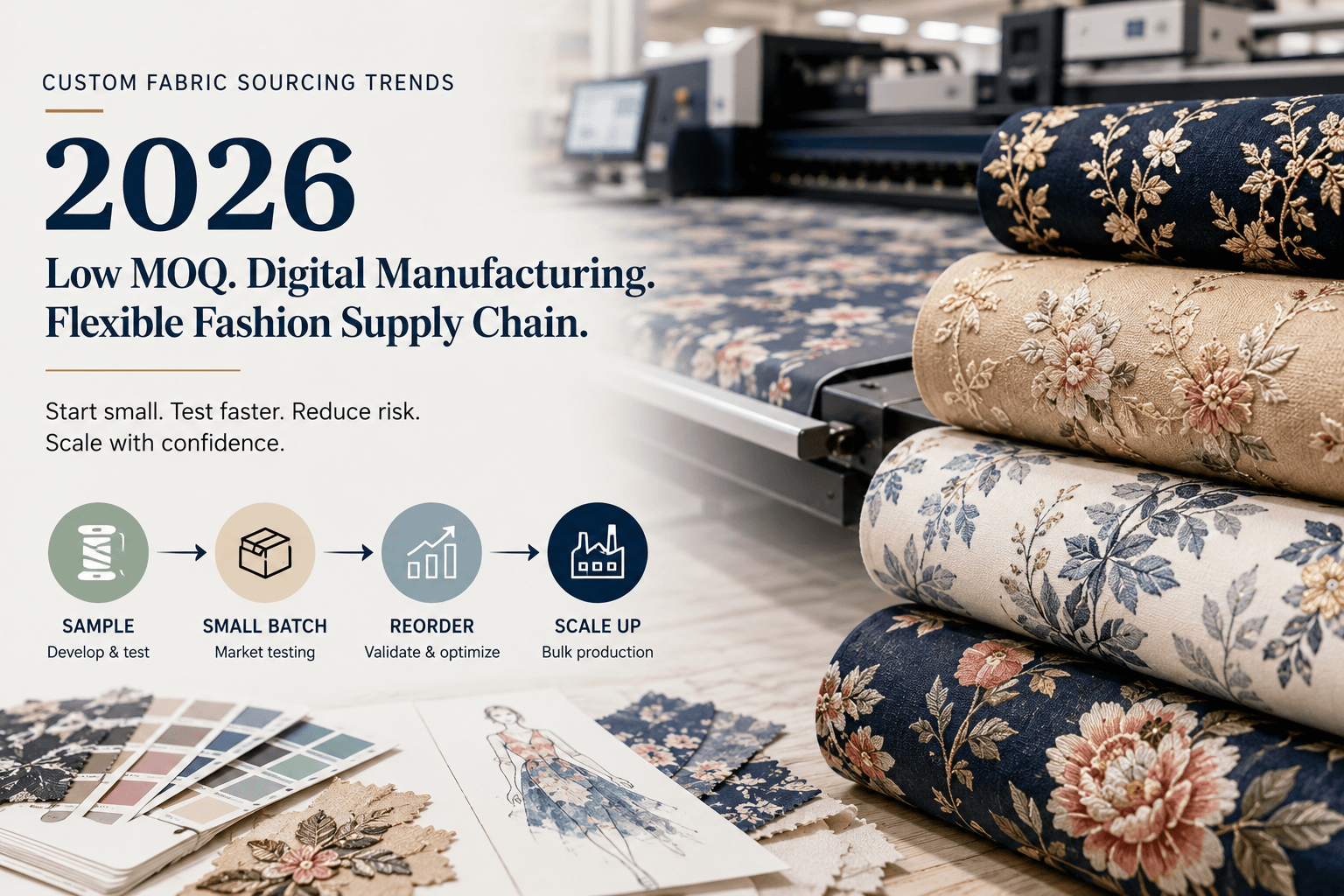
Low MOQ should be understood as a staged development strategy. The purpose is to reduce risk at the beginning and scale production when the product has been validated.
Sampling Stage
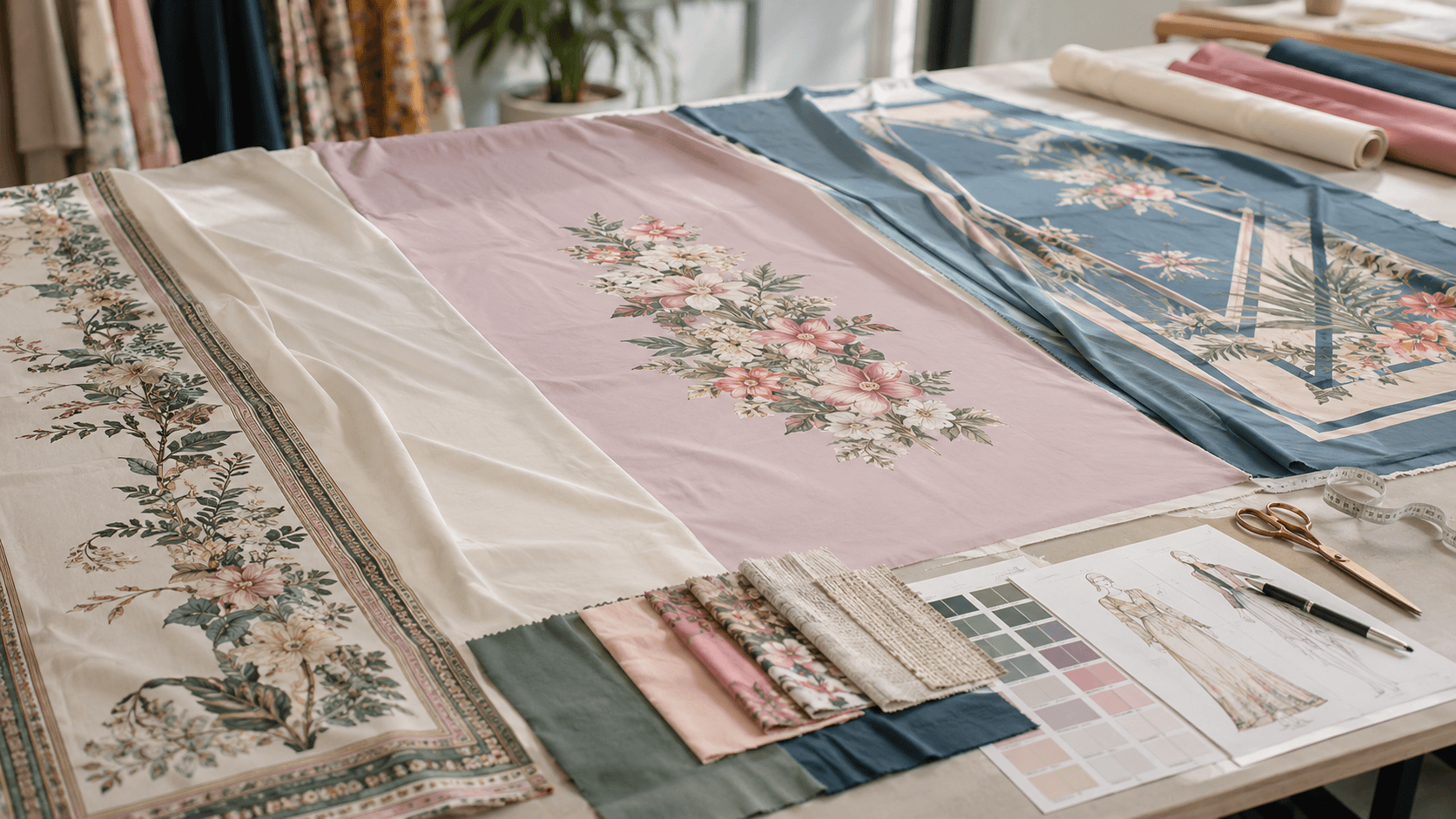
The buyer tests the fabric base, artwork, color direction, embroidery quality, print result, finishing, and hand feel before placing a production order.
Market Testing Stage
The brand launches a small batch, tests customer response, reviews sell-through performance, and identifies which colors, patterns, or styles deserve reorders.
Reorder Stage
Once the design is validated, the buyer can reorder successful fabrics with clearer production data, better demand signals, and lower uncertainty.
Bulk Production Stage
The project moves into larger production only when the buyer has stronger confidence in fabric quality, market demand, and production direction.
Correct sourcing logic: Start small, validate the product, then scale the successful fabric. Low MOQ is not the final goal. It is the starting mechanism for smarter sourcing.
What Fashion Brands Should Ask Before Choosing a Custom Fabric Supplier
Low MOQ and digital manufacturing are useful only when the supplier has a reliable development process. Before choosing a custom fabric supplier, buyers should ask questions that reveal whether the supplier can support real product development, not just quote a low price.
Development Questions
- Can you support sample development before bulk production?
- What is the MOQ by fabric base and process?
- Can you adjust artwork, repeat size, and colorways?
- Can you support digital printing and position printing?
- Can you combine printing, embroidery, jacquard, or mixed fabric techniques?
Production Questions
- How do you control color consistency?
- How do you check fabric defects and finishing quality?
- Can you support repeat orders after small-batch validation?
- How do you manage sample-to-bulk differences?
- Can you provide clear communication during development?
For embroidered fabric buyers, reviewing real embroidered fabric projects can also help evaluate technique range, fabric base selection, and decorative surface capability. For printed fabric buyers, project examples are useful for understanding whether a supplier can manage artwork placement, repeat adjustment, and fabric-specific printing performance.
2026–2027 Outlook: The Future Belongs to Flexible Fabric Supply Chains
The next stage of fabric sourcing will not be defined only by cheaper production. It will be shaped by smaller initial orders, faster digital development, more frequent product launches, and stronger supplier collaboration.
01
Smaller initial orders will help brands reduce product risk before scaling.
02
More frequent launches will increase the need for responsive fabric development.
03
Digital sampling will support faster artwork, print, and color decisions.
04
Traceability pressure will require better supplier data and collaboration.
05
Supplier capability will matter more than choosing by country or price alone.
Compliance pressure is also becoming more important. Vogue Business has reported that fashion compliance and traceability pressure will increase as Digital Product Passport and Extended Producer Responsibility requirements move closer. For fabric buyers, this reinforces the need for suppliers who communicate clearly and understand documentation, materials, and production traceability.
How Zenithfabrics Matches These Trends
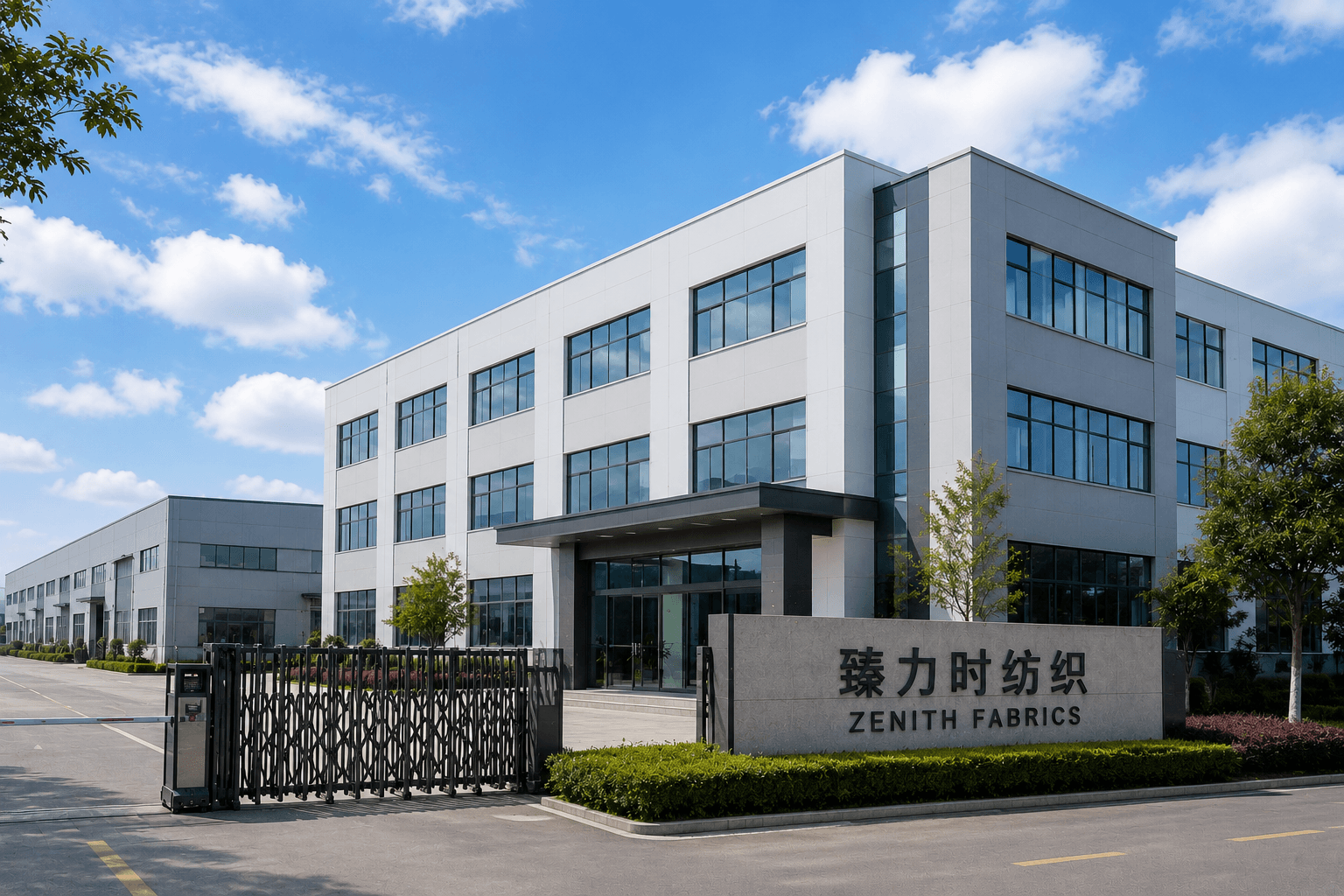
For brands that need flexible fabric development from sample to bulk, Zenithfabrics supports a practical sourcing model built around custom development, low MOQ support, digital printing, embroidery, jacquard weaving, and project coordination from Keqiao, China.
As a custom premium fabric manufacturer, Zenithfabrics focuses on helping buyers evaluate fabric base, artwork direction, technique feasibility, sample results, and scalable production planning. This is especially useful for brands that do not want to begin every project with a large-volume order before testing the design.
Digital Fabric Development
Zenithfabrics supports digital direct printing for custom printed fabrics and digital position printing projects for garment panels, placement prints, borders, and fashion applications that need layout control.
Decorative Fabric Techniques
For buyers developing decorative fashion fabrics, Zenithfabrics also supports custom embroidery services, embroidered fabric projects, and jacquard woven fabric development.
The main advantage is not only having multiple techniques. It is the ability to connect them during development. A buyer may start with a digital print, add embroidery, test a jacquard base, adjust the fabric hand feel, and then move toward a repeatable production plan. This is the kind of flexible supply chain that many fashion brands need in 2026.
Conclusion: The Winning Fabric Supply Chain Is Flexible, Not Just Cheaper
Custom fabric sourcing in 2026 is moving toward low MOQ, digital development, flexible production, and better supplier collaboration. For fashion brands, the best supplier is not always the one offering the lowest unit price at the beginning. It is the supplier that can help reduce development risk, create reliable samples, support small-batch testing, and scale production when the product is validated.
Low MOQ fabric manufacturing is not a shortcut. It is a smarter way to test, learn, and grow. Digital manufacturing is not only about machines. It is about faster decisions, better coordination, and a more responsive custom fabric supply chain.
For buyers developing printed, embroidered, jacquard, or mixed-technique fashion fabrics, the future belongs to suppliers who can combine flexibility with technical control.
Need Low MOQ Custom Fabric Development?
Zenithfabrics supports digital direct printing, digital position printing, custom embroidery, jacquard weaving, and sample-to-bulk development for fashion fabric projects. If you are developing a new collection, our team can help evaluate fabric base, artwork, technique, MOQ, and production direction.
“`
about
Zenithfabrics
Based in Keqiao, Shaoxing — the heart of China's textile industry — Zenithfabrics specializes in high-quality embroidered mesh, embroidery lace, and custom decorative fabrics.