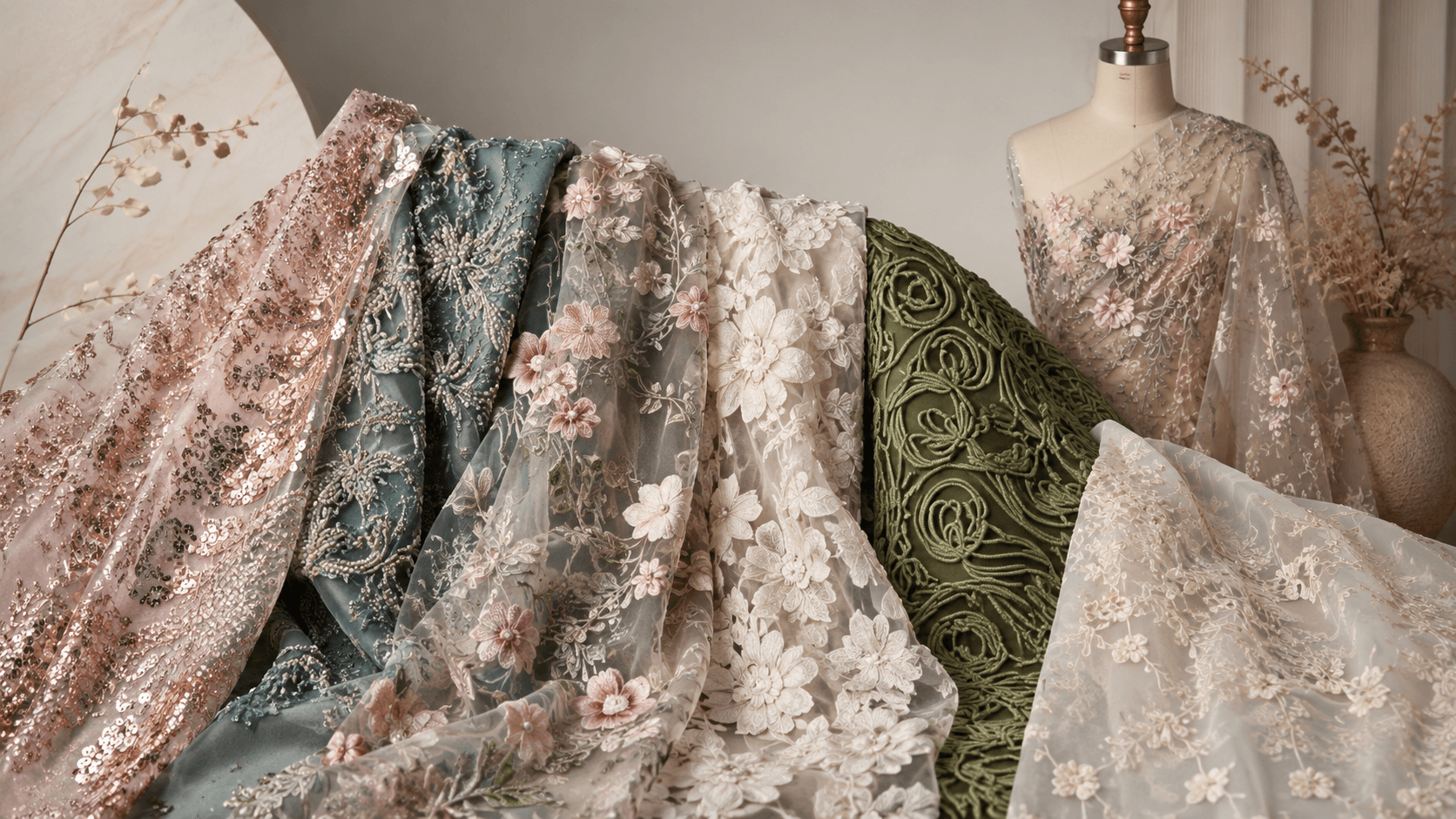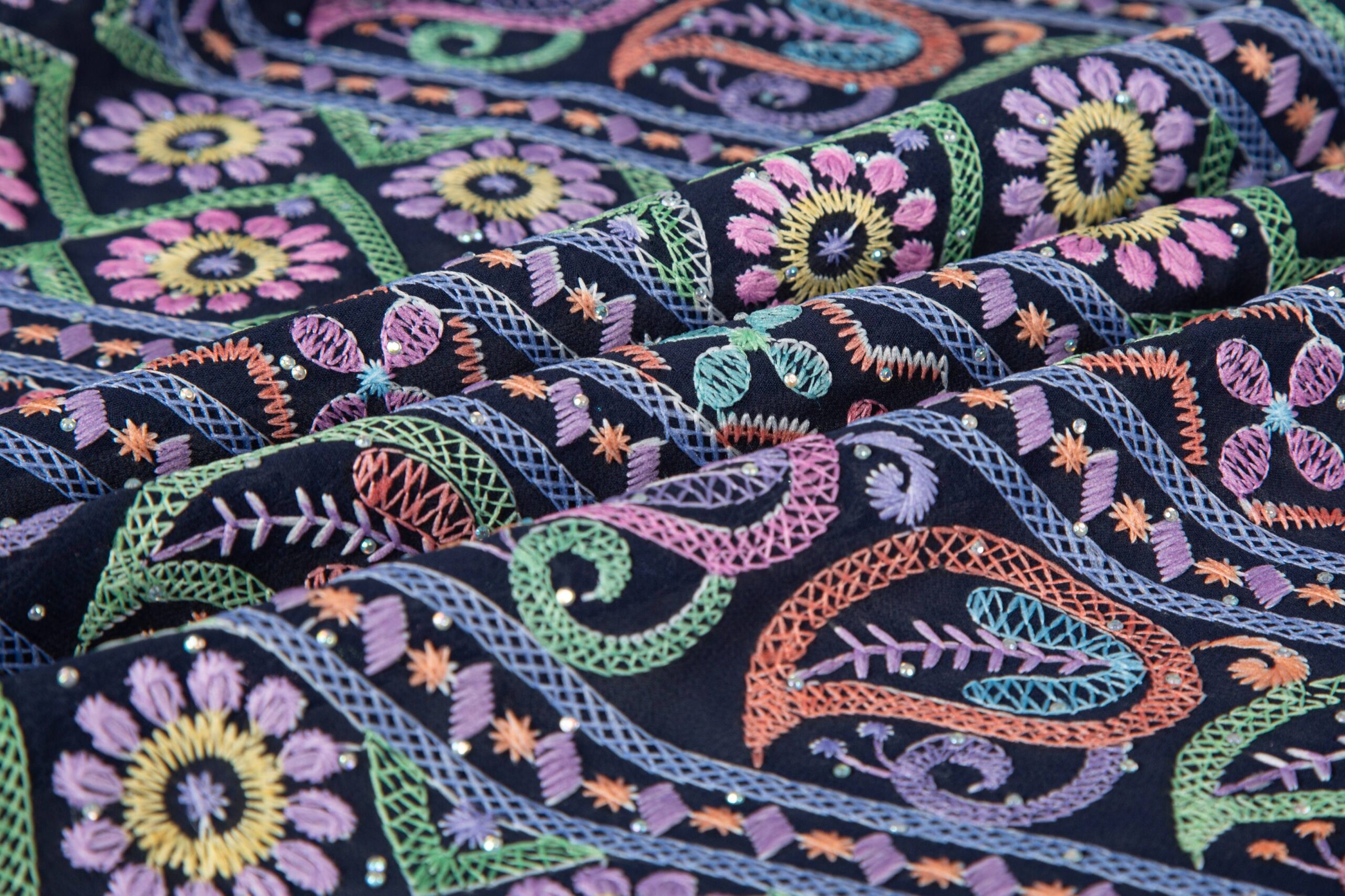
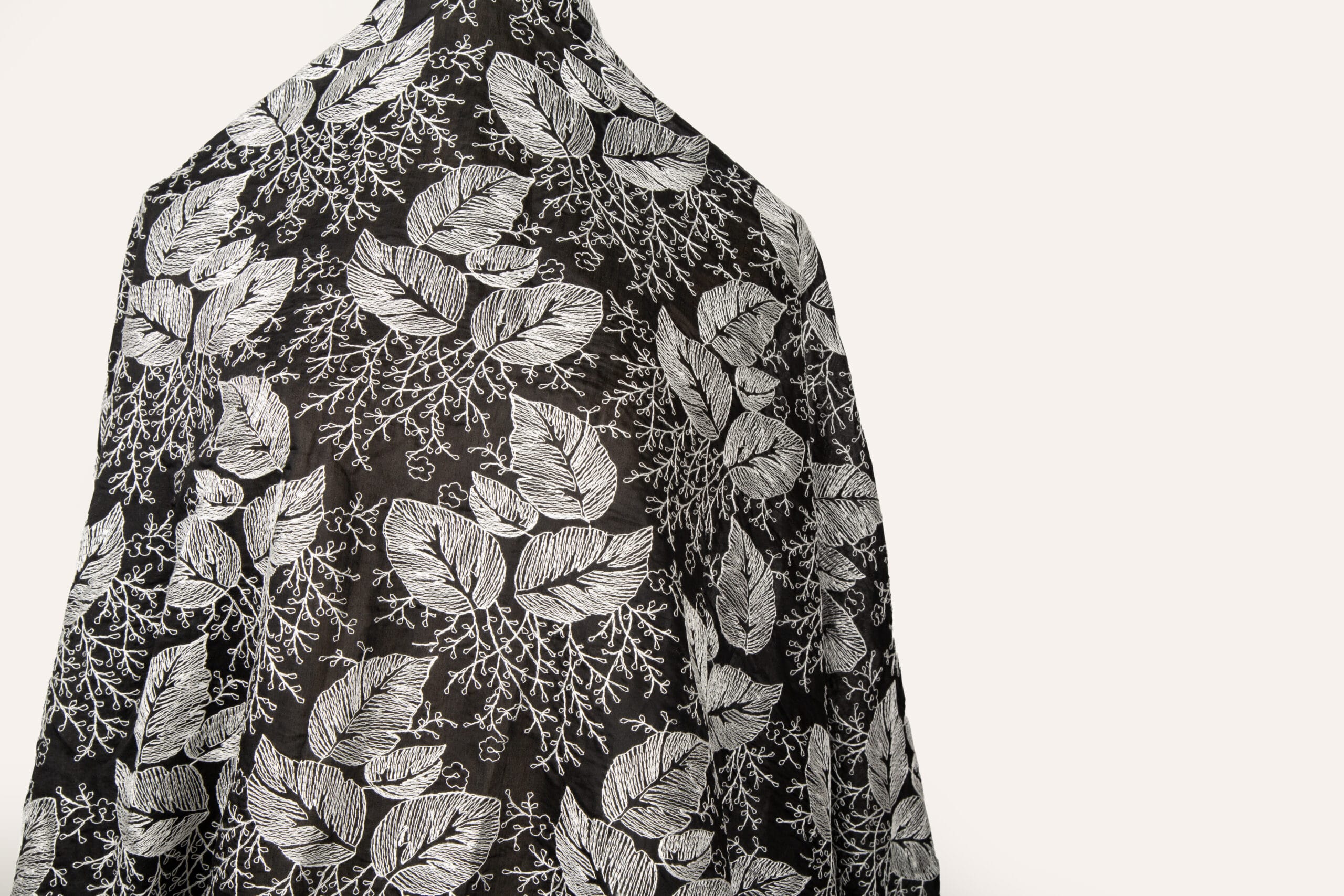
Water soluble embroidery lace is a decorative lace fabric made by embroidering patterns onto a temporary water-soluble base, then dissolving the base so that only the embroidered thread structure remains. In the textile and lace industry, this fabric is also commonly known as chemical lace, and it is often associated with guipure-like lace effects, openwork embroidery, floral motifs, and premium decorative fabric development.
For fashion brands, garment manufacturers, and fabric wholesalers, water soluble embroidery lace is valued because it can create refined lace patterns without relying on a permanent mesh or tulle ground. The result is a fabric that can appear delicate, dimensional, and highly decorative while still offering enough structure for bridalwear, evening gowns, dresses, trims, appliqué motifs, and luxury fashion details.
This guide explains what water soluble embroidery lace is, how it differs from chemical lace and guipure lace, how it is made, where it is used, and how to source custom water soluble lace fabric for fashion production.
What Is Water Soluble Embroidery Lace?
Water soluble embroidery lace is a type of embroidered lace created by stitching decorative patterns onto a temporary water-soluble backing. After the embroidery process is completed, the backing is dissolved in water, leaving only the embroidered thread structure. This creates a lace-like fabric with open spaces, connected motifs, and decorative patterns.
Unlike regular embroidery fabric, where embroidery is stitched onto a permanent base fabric such as mesh, tulle, satin, or cotton, water soluble lace fabric depends on the embroidery structure itself. The design must be carefully digitized so that the stitches remain connected after the base is removed.
This technique is widely used for floral lace, embroidery lace trims, lace motifs, bridal lace fabric, guipure-style lace, and decorative panels for fashion garments. It is especially useful when designers want a more open, refined, and high-end lace effect.
Water soluble embroidery lace can also be combined with other decorative techniques, including sequin embroidery fabric, beaded embroidery, metallic thread embroidery, cord stitching, or appliqué embroidery fabric.
Is Water Soluble Lace the Same as Chemical Lace?
Water soluble lace is often called chemical lace in the embroidery and lace industry. The name comes from the production method: embroidery is created on a temporary base material, and that base is later removed through a dissolving or washing process. After removal, the embroidered thread structure remains as the final lace fabric.
For buyers searching for chemical lace fabric wholesale, this term usually refers to lace products made with a similar soluble-base embroidery process. In many markets, especially among European buyers, chemical lace is a familiar industry term for this kind of embroidery lace.
However, chemical lace should not be confused with every type of lace. It describes a production method, while other lace terms may describe structure, appearance, or historical lace categories.
| Term | Meaning | Buyer Search Intent |
|---|---|---|
| Water Soluble Embroidery Lace | Embroidery lace made on a soluble backing that is later removed | Precise product and sourcing search |
| Chemical Lace | Industry term for lace produced by dissolving a temporary base | Common B2B and wholesale search term |
| Guipure Lace | A broader lace category with connected motifs and open spaces | Commercial lace fabric search |
| Laser Cut Embroidery Lace | Embroidery lace with laser-cut edges or cutout finishing | Process-specific sourcing search |
Water soluble embroidery lace can create guipure-like lace effects, but guipure lace fabric is a broader lace category. Some guipure lace may be produced with water-soluble embroidery methods, while other guipure-style lace may be made through different lace-making or embroidery processes.
How Water Soluble Embroidery Lace Is Made
The production of water soluble embroidery lace requires accurate embroidery digitizing, stable thread connection, and careful finishing. Because the temporary base is removed after embroidery, the stitch structure must be strong enough to hold the final lace shape.
For some designs, laser cutting is also used after embroidery to create cleaner openings, sharper outlines, and more precise lace motif edges. This is why some buyers search for laser cut embroidery lace fabric when they need both embroidered lace structure and precise cutwork finishing.
- 1
Artwork development — The lace pattern is designed according to the required motif style, repeat size, garment application, and production method.
- 2
Embroidery digitizing — The artwork is converted into an embroidery file. Stitch density, thread direction, connection points, and edge structure must be planned carefully.
- 3
Water-soluble backing preparation — A temporary soluble base is prepared to support the embroidery during machine production.
- 4
Machine embroidery — Multi-head embroidery machines stitch the lace pattern onto the water-soluble base.
- 5
Washing and base removal — The soluble backing is removed, leaving only the embroidered lace structure.
- 6
Laser cutting or trimming — For some designs, laser cutting is used to refine edges, create clean openings, or shape lace motifs more precisely.
- 7
Inspection and finishing — The lace is checked for thread stability, edge quality, pattern accuracy, color consistency, and production defects.
The quality of water soluble lace fabric depends heavily on stitch density and motif connection. If the embroidery is too loose, the lace may lose shape after washing. If the embroidery is too dense, the fabric may become stiff, heavy, or unsuitable for certain garments.
Key Features of Water Soluble Lace Fabric
Water soluble lace fabric is used when a design requires openwork structure, decorative detail, and a refined lace appearance. Compared with ordinary embroidered mesh fabric, it can create stronger lace identity because the embroidery itself becomes the fabric structure.
| Feature | Description |
|---|---|
| Openwork lace structure | The soluble base is removed, creating lace motifs with open spaces. |
| Clean motif definition | Embroidery patterns can be shaped into flowers, borders, geometric forms, or custom artwork. |
| Premium decorative effect | Suitable for bridalwear, eveningwear, dresses, and luxury fashion garments. |
| Design flexibility | Can be developed as lace trims, motif patches, fabric panels, or yardage patterns. |
| Combination potential | Can be combined with sequins, beads, cords, metallic threads, or 3D embroidery elements. |
| Custom production value | Suitable for exclusive fabric development and repeatable wholesale production. |
For more complex decorative effects, water soluble lace can also be developed with 3D tape embroidery fabric, cord embroidery fabric, beads, sequins, or layered appliqué details.
Types of Embroidered Lace for Fashion Garments
There are different types of embroidered lace used in fashion fabric development. The right choice depends on the garment category, motif size, transparency, decoration level, and production requirements.
| Type | Best For | Visual Effect |
|---|---|---|
| Water Soluble Embroidery Lace | Bridalwear, dresses, trims, lace motifs | Openwork, refined, lace-like embroidery structure |
| Chemical Lace Fabric | Wholesale lace fabric, garment panels, decorative trims | Connected motifs with a clean lace appearance |
| Guipure-Style Lace Fabric | Evening gowns, occasionwear, luxury fashion | Bold connected motifs and strong decorative identity |
| Water Soluble Lace Trim | Hems, sleeves, collars, veils, garment edges | Decorative border effect and placement-focused detail |
| 3D Water Soluble Lace Fabric | Couture, bridal accents, premium fashion details | Raised texture, dimensional floral motifs, luxury effect |
| Laser Cut Embroidery Lace Fabric | Modern fashion, precise motifs, cutwork details | Clean edges, cutout structure, sharp pattern definition |
| Beaded or Sequin Lace Fabric | Eveningwear, partywear, bridal gowns | Sparkle, texture, and decorative light reflection |
Water Soluble Lace vs Guipure Lace
Many buyers compare water soluble lace with guipure lace because both can have connected motifs, open spaces, and a strong decorative structure. However, the two terms are not always identical.
Water soluble lace usually refers to the production process. It is made by embroidering on a soluble base and removing that base after production. Guipure lace refers more broadly to a lace style with motifs connected by bars or threads instead of a fine net ground.
In practice, water soluble embroidery can be used to produce guipure-like lace effects. For sourcing, buyers may search for both water soluble lace fabric and guipure lace fabric suppliers when looking for similar decorative lace products.
| Comparison | Water Soluble Lace | Guipure Lace |
|---|---|---|
| Main meaning | Production method using soluble backing | Lace structure or style category |
| Base fabric | Temporary base is removed after embroidery | Usually no fine net ground between motifs |
| Visual effect | Openwork embroidery lace | Connected decorative motifs |
| Buyer use | Precise sourcing term for soluble embroidery lace | Broader commercial lace fabric search term |
Applications of Water Soluble Embroidery Lace
Water soluble embroidery lace is widely used in fashion categories where lace detail, light structure, and premium decoration are important. It can be produced as lace fabric yardage, lace trims, border embroidery, motif patches, garment panels, or decorative inserts.
| Application | Why It Works |
|---|---|
| Bridal gowns | Creates romantic lace motifs, floral details, and refined decorative surfaces |
| Evening gowns | Adds luxury lace texture, openwork decoration, and high visual impact |
| Dresses | Provides decorative lace elements without relying on heavy embroidery coverage |
| Blouses and tops | Suitable for collars, sleeves, panels, and elegant lace accents |
| Lace trims | Useful for hems, cuffs, neckline details, and garment edge decoration |
| Couture fashion | Supports custom motif development, complex lace structures, and exclusive designs |
| Accessories | Can be used for decorative patches, headpieces, trims, and special textile details |
For bridalwear, water soluble embroidery lace can create floral lace motifs for gowns, veils, overskirts, and bodice details. For eveningwear, it can be developed with beads, sequins, metallic threads, or laser-cut finishing to create stronger decorative effects.
For fashion collections, this technique allows brands to develop exclusive lace patterns, custom trims, special motif placements, and fabric designs that are difficult to achieve with standard ready-made lace.
How to Source Custom Water Soluble Lace Fabric
When sourcing custom water soluble lace fabric, buyers should evaluate both design appearance and production feasibility. A lace sample may look attractive, but bulk production also requires stable embroidery structure, consistent motif shape, clean finishing, and suitable garment performance.
Before starting a custom project, it is useful to confirm the following details:
- Artwork or reference design
- Intended garment application
- Lace fabric width, motif size, or trim width
- Thread type, color, and stitch density
- Water-soluble embroidery structure
- Whether laser cutting or trimming is required
- Additional embellishments such as sequins, beads, pearls, cords, or metallic threads
- Sample approval process and bulk production requirements
For buyers looking for a water soluble lace fabric supplier or water soluble embroidered fabric manufacturer, production capability matters as much as design appearance. The manufacturer should be able to review artwork, adjust embroidery structure, create samples, and maintain consistent quality during bulk production.
Zenithfabrics provides custom embroidery services for fashion brands, garment manufacturers, and fabric wholesalers, supporting embroidery development from design review and sampling to bulk production.
Custom Water Soluble Embroidery Lace Manufacturer
As a custom embroidery fabric manufacturer, Zenithfabrics develops water soluble embroidery lace, chemical lace fabric, laser cut embroidery lace fabric, and decorative embroidered fabrics for fashion brands and wholesalers.
Our embroidery development can support floral lace patterns, guipure-style motifs, lace trims, bridal lace fabric, eveningwear lace, and mixed embellishment designs. Depending on the project, water soluble embroidery lace can be combined with sequins, beads, cords, metallic threads, 3D details, or appliqué elements.
You can also explore our embroidered fabric projects to see different embroidery techniques used for fashion fabric development, or contact us through our contact page to discuss custom water soluble embroidery lace for your next collection.
Custom Lace Development
Support for artwork review, embroidery digitizing, soluble backing selection, sampling, laser-cut finishing, and custom lace development.
Bulk Embroidery Production
Consistent water soluble embroidery lace production for fashion brands, garment manufacturers, wholesalers, and custom fabric projects.
Water Soluble Embroidery Lace for Fashion Brands
Zenithfabrics develops custom water soluble embroidery lace and chemical lace fabric for fashion brands, garment manufacturers, and fabric wholesalers. From design development and sample review to bulk embroidery production, we help clients create decorative lace fabrics suitable for bridalwear, eveningwear, dresses, trims, and custom fashion collections.
about
Zenithfabrics
Based in Keqiao, Shaoxing — the heart of China's textile industry — Zenithfabrics specializes in high-quality embroidered mesh, embroidery lace, and custom decorative fabrics.